



The Case for Quiet Buildings
In a city that competes for attention at every corner, we keep asking the same question: what if a building simply didn’t?
Walk down almost any block in Los Angeles and you can feel it. Buildings trying too hard. Facades layered with materials that don’t speak to each other. Windows pushed and pulled for effect rather than necessity. Architecture that announces itself, but doesn’t hold.
There’s a kind of visual fatigue in that.
We’ve been building the opposite.
Not because restraint is a trend, and not because we’re allergic to ambition. It’s something we’ve learned through the work itself: the buildings we’re most proud of share a specific quality. You can’t always point to what makes them work. They just do. They hold up. They wear well. They make the street around them a little better than they found it.
Three recent projects made that position explicit.
Lexington5806 — East Hollywood
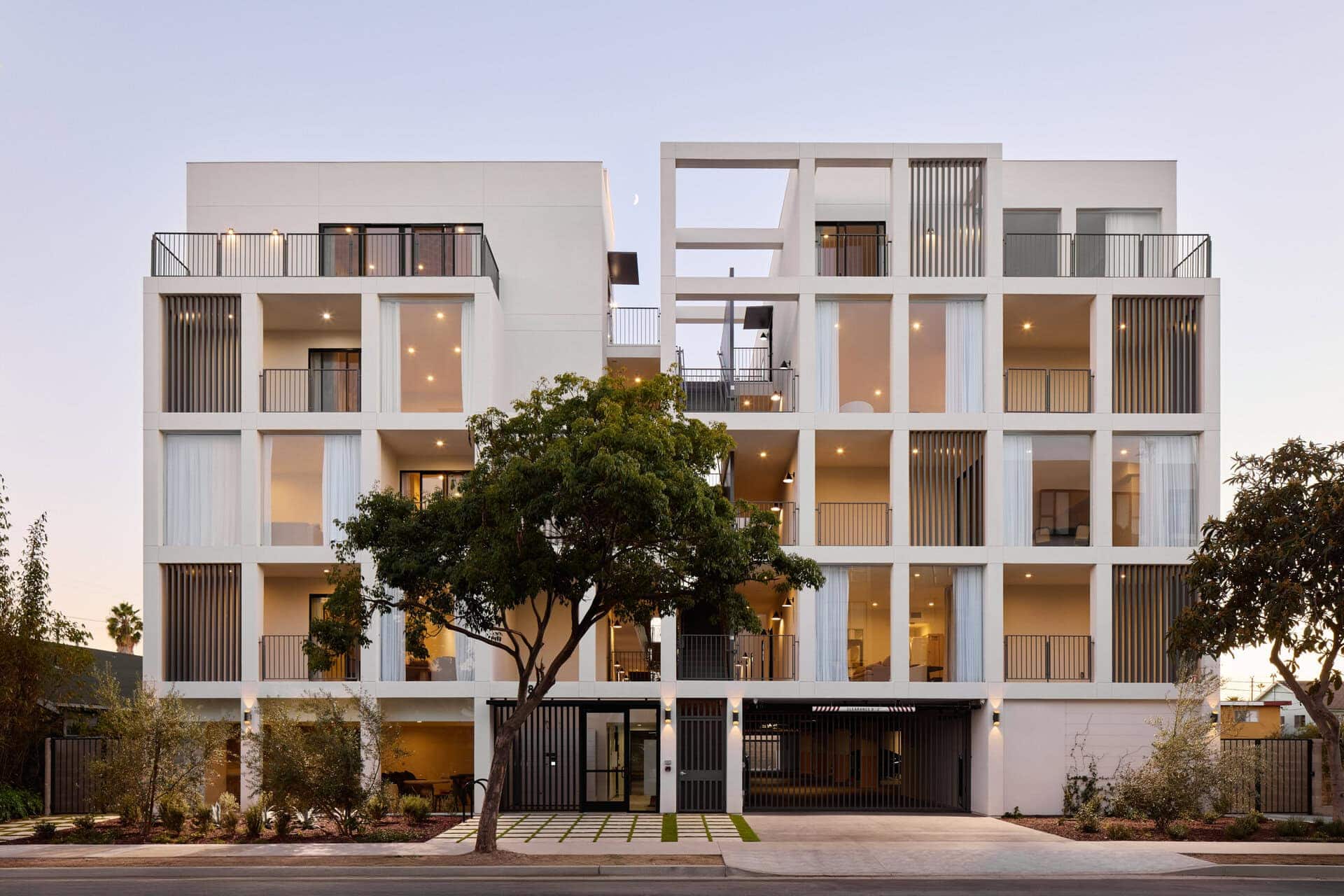
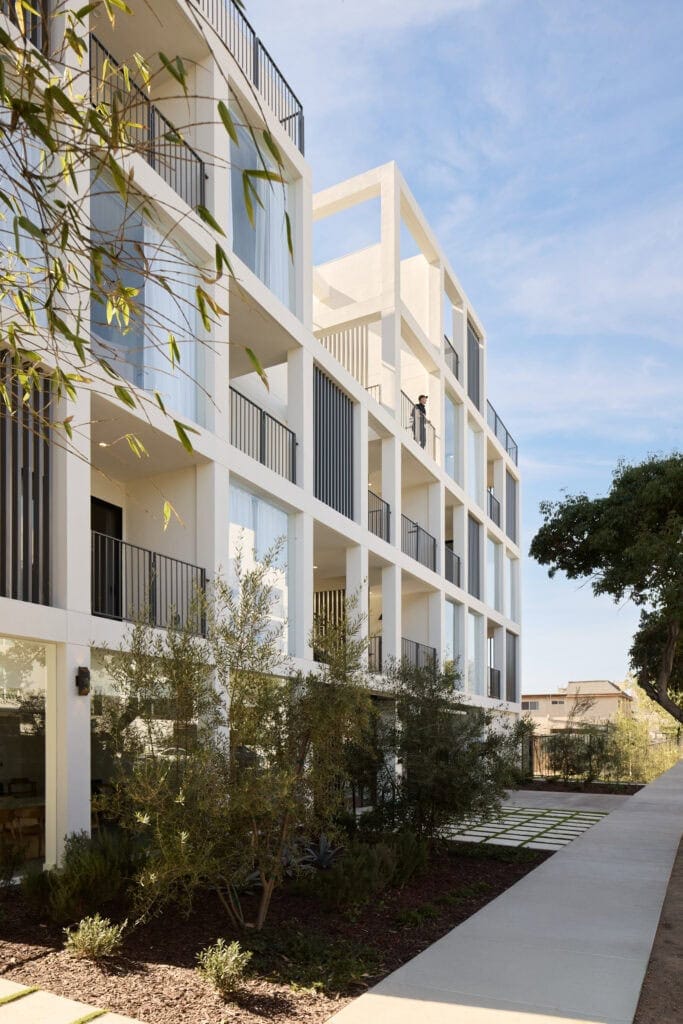
Lexington is organized around one move: a continuous concrete grid.
Deep reveals, large openings, a rhythm that reads as both structural and compositional. The facade isn’t applied. It is the building.
People often ask what’s holding it up.
The answer is simple: the facade is holding itself up.
The loudest thing about Lexington is how quiet it is. In a neighborhood where every building is trying to say something, this one just stands there. That restraint gives it presence.
The existing street tree anchors the entry. That wasn’t incidental. The approach, the threshold, the planted forecourt all organize around it. In most projects, a tree like that is something to work around. Here, it became the front door.
At dusk, when the apartments warm behind the grid and the reveals fill with shadow, the building does something most housing in LA doesn’t. It looks inhabited. Not just occupied. Inhabited.
Purdue2460 — West Los Angeles
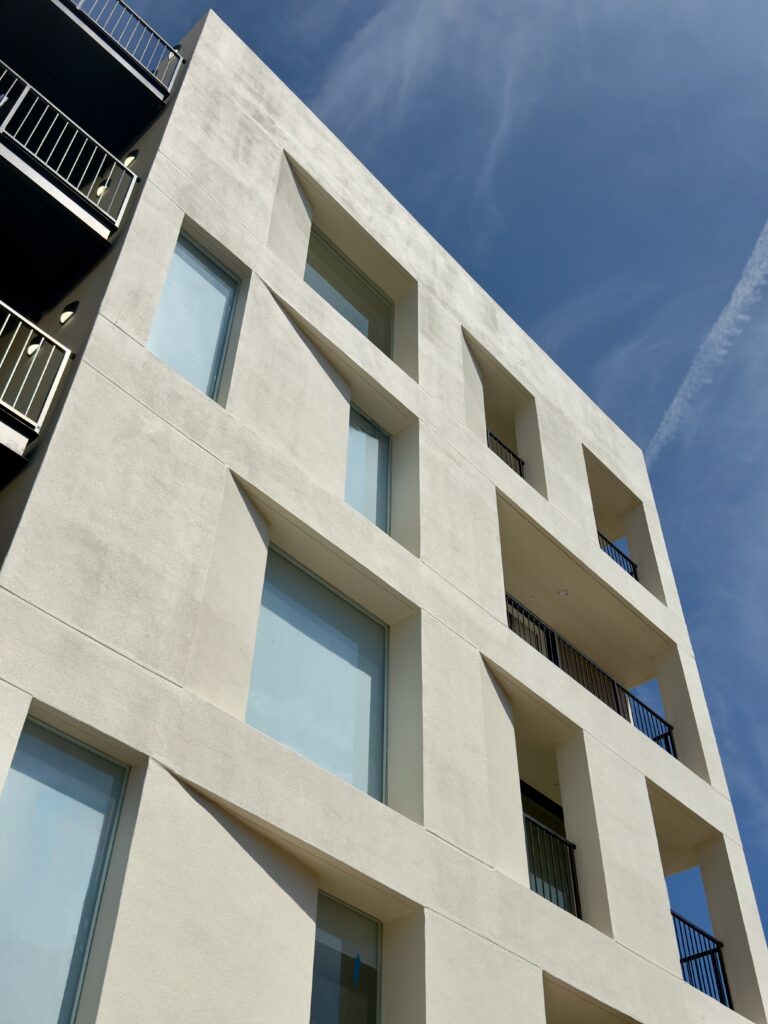
Purdue presented a different problem. A tight site, a dense program, and a neighborhood in transition.
The answer wasn’t in the surface. It was in the massing.
Two volumes, pulled apart by a central notch. That notch brings light into the courtyard, creates a moment of arrival, and breaks down the building’s apparent scale from the street without fragmenting its presence.
One move, doing multiple things.
Everything else is secondary. The exterior is restrained. No applied ornament. No material gesture that needs explanation. The building’s character comes from its form, and its form comes from a decision made early and held onto.
Melrose — Beverly Grove
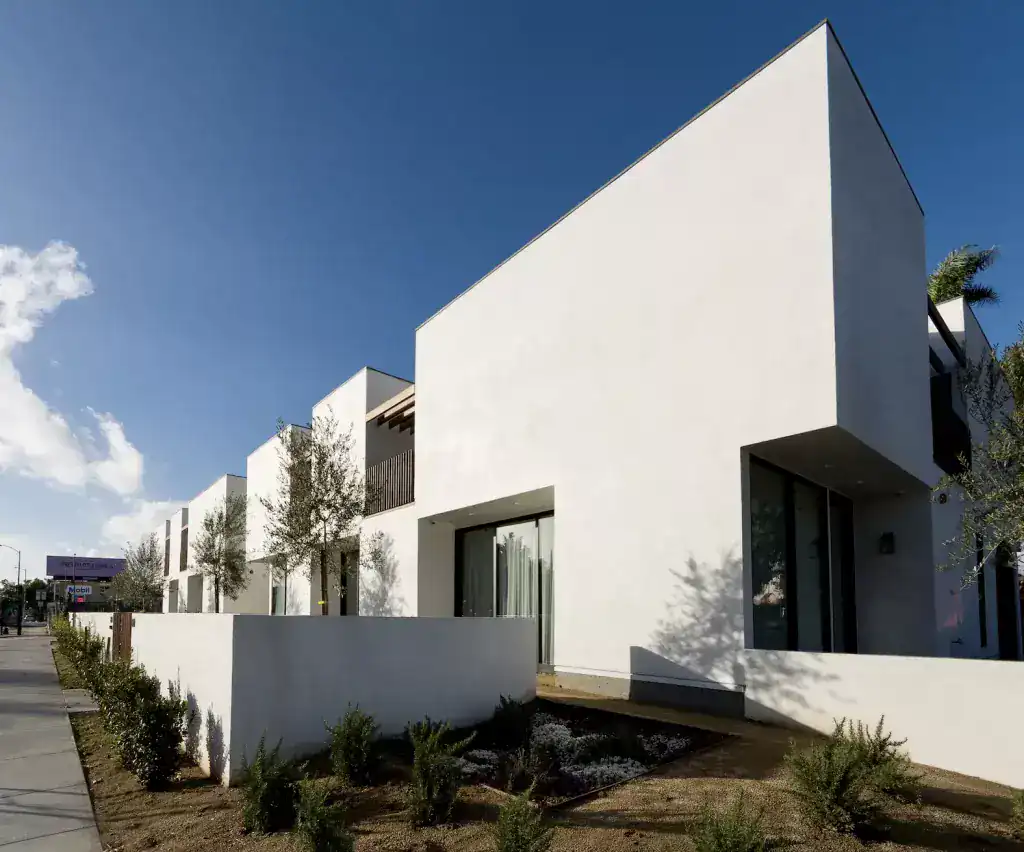
If Lexington is about surface and Purdue is about mass, Melrose is about the edge.
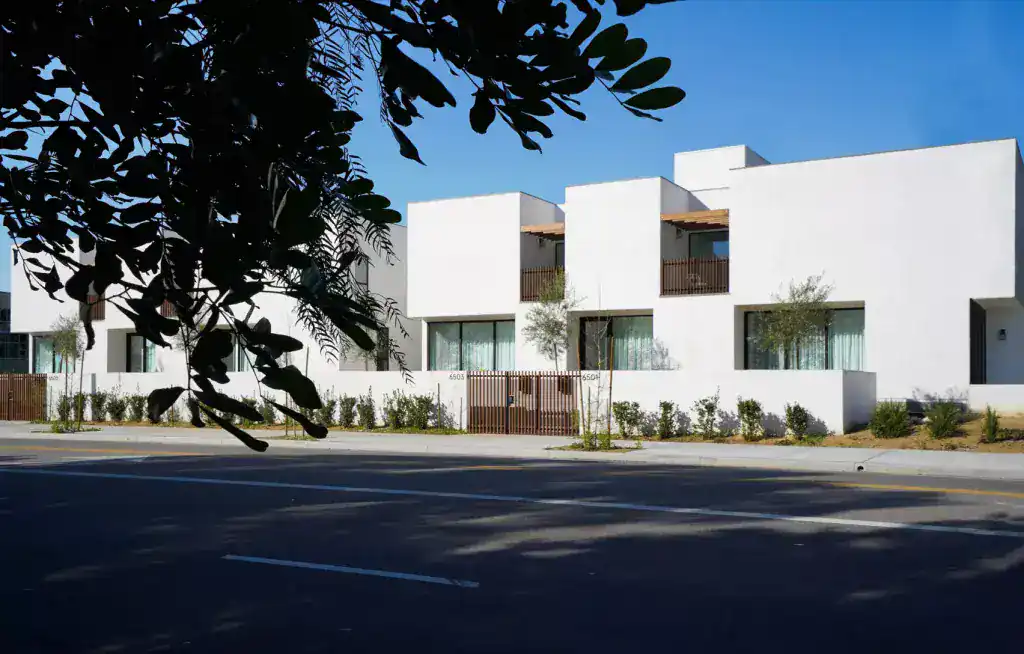
Most multifamily architecture in Los Angeles turns its back on the sidewalk. Podiums, gates, blank frontages. The building signals: nothing for you here.
Melrose takes the opposite position.
Each unit has its own address, its own entry from the street, its own planted threshold. A low wall defines the boundary without closing it off.
The olive trees along the front are already doing what they were intended to do. Softening the line between building and ground. Breaking the plane. Giving the project a sense of belonging to the block rather than being placed on it.
In time, it will feel like it’s always been there. That’s the goal.
What this points to
None of these buildings are trying to surprise you. They’re not chasing a moment or designed for a single photograph.
They’re designed to be lived in. To age well. To hold their ground on the street over time.
What they share is a way of working.
Find the one idea the site and the program are actually asking for, and follow it all the way through.
The grid at Lexington.
The notch at Purdue.
The wall and the trees at Melrose.
Each one simple. Each one difficult to hold onto as budgets tighten and complexity pushes in.
That’s the work.
We’re not interested in adding complexity to make a building feel considered. We’re interested in removing everything that isn’t essential, so what matters can read clearly.
In a city that rewards noise, we’re interested in what happens when a building is quiet.
Because the buildings that last aren’t the ones that asked for attention.
They’re the ones that earned it.