



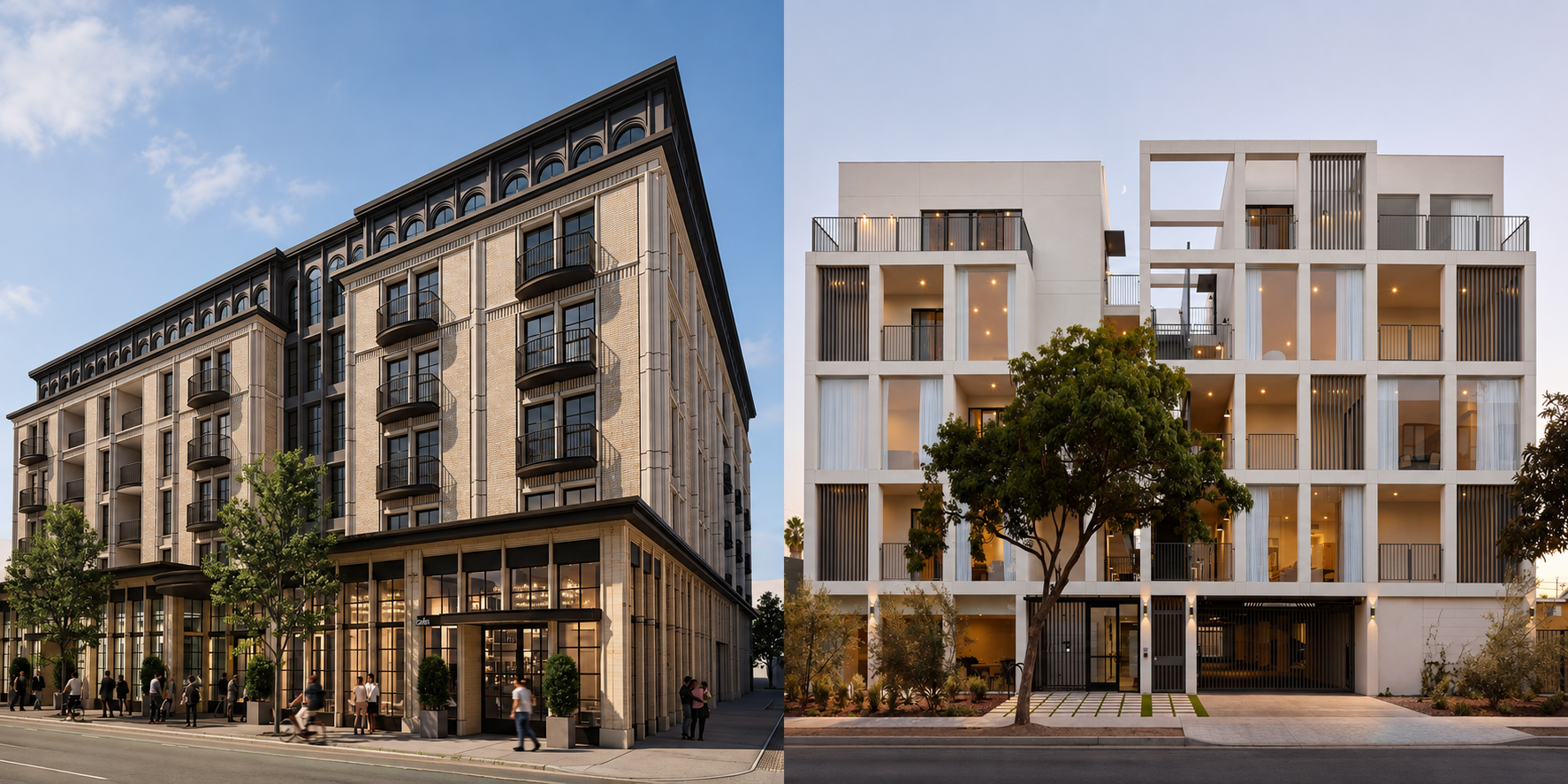
We Don’t Start With a Style
I’ve never wanted Bittoni Architects to have a recognizable style.
In fact, if you can immediately recognize one of our buildings because it looks like the last one we designed, I’m not sure we’re doing our job.
Every project gives us a different set of circumstances. A different site, a different client, a different program, a different budget and a different place. Why should all of those things lead to the same architectural answer?
They shouldn’t.
That idea has become much more apparent as our work has expanded between Los Angeles and Charleston.
Right now we can be working on a house in Los Angeles one day and a large mixed use project in Charleston the next. Those projects have almost nothing in common visually. But the way we work on them is surprisingly similar.
We don’t start by deciding what something should look like.
We start by trying to understand the problem.
On a house, that might mean figuring out what you see when you walk through the front door, how the living spaces connect to the outside, or why one part of an elevation just doesn’t feel right.
On a much larger project, we’re asking a lot of the same questions. Where do you enter? What do you see when you get there? Does this feel too big? How does it meet the street?
We can spend an hour moving a window six inches on a house and then have essentially the same conversation about moving an entire building.
There is one thing that does show up pretty consistently in our work, though.
We tend to make things simpler.
Some of our projects that stand out the most are actually doing very little. There may be one strong opening, one material, or one move that organizes the whole building. That sounds easy. It usually isn’t.
The temptation in architecture is always to add something. Another material. Another window. Another gesture to make the building more interesting.
We usually find ourselves going the other direction.
We take things away until what’s left actually matters.
And strangely, that can make a building stand out more. When everything around you is trying to get your attention, a building that is quiet and confident can have a much stronger presence.
That isn’t a style either. At least I don’t think it is. It’s more of an instinct about when to stop.
The same applies to context.
We’re not interested in making a new building in Charleston look historic simply because Charleston is historic. And we don’t think a house in Los Angeles needs to look like someone’s idea of California modernism.
What interests us is why buildings in those places developed the way they did.
There’s usually something useful underneath the style.
Climate. Shade. Privacy. How people arrive. How a building meets the street. How you move between inside and outside. How big something feels when you’re standing next to it.
Those things can actually inform a design. Copying the appearance of what came before usually doesn’t.
So our projects may not look particularly related.
That’s fine.
We don’t have a material palette that needs to appear on every project. We don’t have a particular window or roof or detail that makes something a Bittoni building.
If there is a connection, I hope it’s harder to see than that.
It’s in the decisions that got us there.